

Bring your spouse to the United States.
The CR-1 and IR-1 spouse visas let the husband or wife of a U.S. citizen or permanent resident immigrate to the U.S. and become a green-card holder. We handle it end to end, from petition to approval.
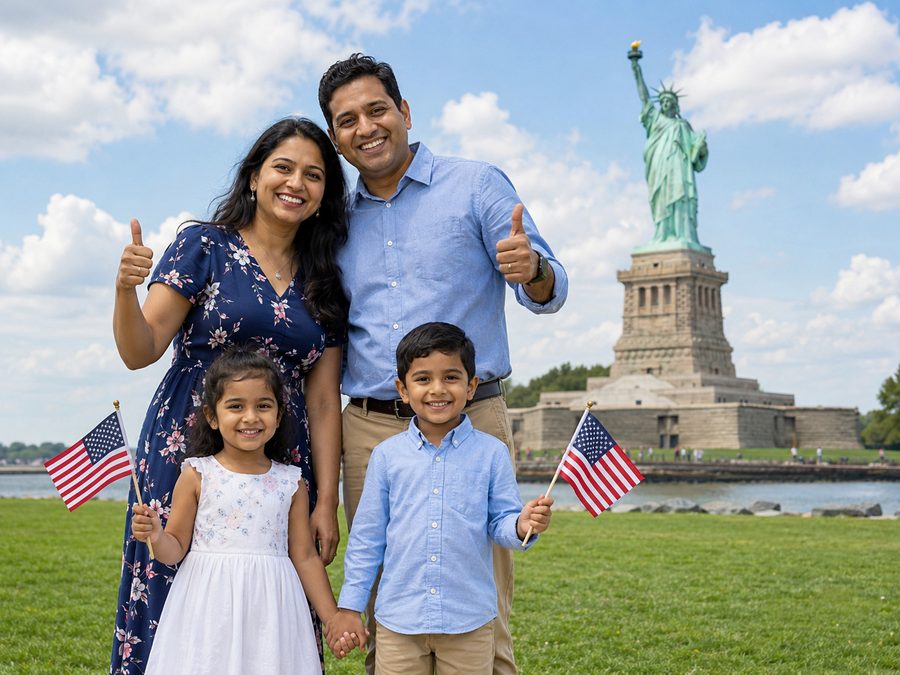
- The spouse visa (CR-1/IR-1). An immigrant visa processed at a U.S. consulate; your spouse enters the United States as a lawful permanent resident.
- A U.S. citizen's spouse is an "immediate relative" — no annual visa cap and no wait line. (Married to a green-card holder instead? That's the F2A path. It can wait for a visa number, as explained below.)
- We handle the whole filing. The I-130 petition, the DS-260 immigrant visa application, and the I-864 affidavit of support.
- Relationship evidence done right. We build the evidence packet, manage NVC follow-ups, and prepare you for the consular interview.
- From intake to approval. A licensed U.S. immigration attorney stays on your file the entire way.
The spouse visa (CR-1 and IR-1)
The CR-1 and IR-1 are immigrant visas for the foreign-born spouse of a U.S. citizen. For nearly every married couple, they are the best route to bring a spouse to the United States. Your spouse applies at a U.S. consulate at home. On entry to the United States, your spouse becomes a lawful permanent resident (green-card holder). There is no separate green-card application to file afterward. The spouse of a U.S. citizen is an "immediate relative". That means no annual visa cap and no wait line. The case moves as fast as the agencies can process it.
CR-1 and IR-1 are the same visa. The only difference is how long you have been married when your spouse is admitted:
- CR-1 (Conditional Resident): issued when the marriage is less than two years old on the day your spouse is admitted. The green card is "conditional" for two years. You jointly file Form I-751 to remove the condition in the 90 days before its second anniversary.
- IR-1 (Immediate Relative): issued when the marriage is two years or older at admission — a ten-year green card, no conditions, no I-751 step.
Either way, your spouse is a permanent resident from the day of entry. The CR-1 condition only confirms, two years on, that the marriage is genuine.
Married to a green-card holder, not a citizen?
Then the category is different. The spouse of a lawful permanent resident is not an immediate relative. This falls under the family second preference (F2A). The petition and consular steps are the same. But F2A has a yearly numerical limit. So there can be a wait for a visa number to become available. The State Department tracks it on the monthly Visa Bulletin. When the sponsoring spouse naturalizes, the case converts up to the no-wait immediate-relative category.
If you are not yet married, the practical answer is usually simple: marry, then pursue the spouse visa. It is faster and cleaner than the alternative. See the note on the K-1 fiancé visa below.
How the spouse-visa process works
A spouse-visa case passes through three government bodies — USCIS, the National Visa Center, and a U.S. consulate:
- Petition (USCIS). The U.S. citizen files Form I-130 to establish the marriage. The core of this step is proving the marriage is bona fide: real, not entered to obtain an immigration benefit.
- National Visa Center. After the petition is approved, the case moves to the NVC. We prepare the online immigrant visa application (DS-260) and the affidavit of support (I-864). We assemble the civil and financial documents.
- Consular interview. Your spouse attends an interview at the U.S. consulate in their country of residence. A consular officer decides the visa under the State Department's Foreign Affairs Manual (9 FAM 502.1).
- Entry as a permanent resident. Your spouse enters on the immigrant visa and is admitted as a lawful permanent resident — CR-1 (conditional) if you have been married under two years, IR-1 otherwise.
- Remove conditions, if CR-1. Near the two-year mark we file Form I-751 to convert the conditional card to a ten-year one.
Where spouse-visa cases go wrong
- Thin proof the marriage is bona fide. This is the heart of the case. A marriage found to have been entered to evade the immigration laws is barred permanently. Even a genuine marriage can draw a Request for Evidence when the relationship record is thin.
- The affidavit of support falls short. The petitioner must show income (or assets) at or above the threshold for the household size, or add a joint sponsor.
- Civil-document or prior-immigration problems. Missing or non-compliant records, past overstays, or earlier filings are best identified and fixed before the interview, not discovered at it.
How we help
We prepare and review every form and exhibit, build the relationship-evidence packet, manage NVC follow-ups, prepare you and your spouse for the interview, and respond to any Requests for Evidence. A licensed U.S. immigration attorney stays on the file from intake through approval.
Common questions.
What's the difference between a CR-1 and an IR-1?
Both are immigrant visas for spouses. A CR-1 is issued when the marriage is under two years old at entry (a two-year conditional green card, later made permanent with Form I-751). An IR-1 is issued when the marriage is two years or older at entry — a ten-year green card, no conditions.
Can a green-card holder sponsor a spouse?
Yes. Both U.S. citizens and lawful permanent residents can petition for a spouse with Form I-130. A citizen's spouse is an immediate relative with no annual wait line; a permanent resident's spouse falls under the family-preference categories.
What if my spouse is already in the U.S.?
If your spouse entered lawfully and is otherwise eligible, adjustment of status (Form I-485) may be available from inside the United States. See the PowerVisa Green Card page.
Does income matter?
Yes. The petitioner must meet the I-864 affidavit-of-support income threshold for the household size. A joint sponsor can be used if income is below the threshold.
What is a "conditional" green card?
If you have been married less than two years when your spouse is admitted, the first green card is conditional for two years (a CR-1). It carries the same rights as any green card; you simply file Form I-751 together in the 90 days before its second anniversary to remove the condition and receive the ten-year card. Marriages two years or older at admission (IR-1) skip this step.
Sources
This page summarizes federal immigration law and official government guidance in plain language. It is general information, not legal advice.
- Immediate relatives — spouse of a U.S. citizen — INA § 201(b)(2)(A)(i) (8 U.S.C. § 1151).
- Family second preference, F2A — spouse of a permanent resident — INA § 203(a)(2)(A) (8 U.S.C. § 1153).
- Petition for a relative (Form I-130) and the marriage-fraud bar — INA § 204 (8 U.S.C. § 1154); 8 CFR § 204.2.
- Conditional residence and removing conditions (Form I-751) — INA § 216 (8 U.S.C. § 1186a); 8 CFR § 216.4.
- Affidavit of support (Form I-864) — INA § 213A (8 U.S.C. § 1183a); USCIS Policy Manual, Vol. 8, Pt. G, Ch. 6.
- Consular processing — U.S. Department of State, travel.state.gov (Foreign Affairs Manual, 9 FAM 502.1; DS-260; monthly Visa Bulletin).
- USCIS forms — I-130, I-864, I-751.
A note on the K-1 fiancé visa. For couples who are engaged but not yet married, a K-1 fiancé visa is a separate route. But it is the last option we recommend. The K-1 requires a second, separate green-card (adjustment-of-status) filing after the wedding. Recent policy changes have made it slower and more burdensome. For nearly all couples, marrying and pursuing the CR-1/IR-1 spouse visa is faster, less expensive, and simpler. If you believe the K-1 is right for your situation, we're glad to talk it through — get in touch.
Bring your spouse home.
Free consultation with a U.S. immigration attorney. No obligation.